Shaking The Maya Tree

If we shook a tree that was full of ripe oranges, we would–quite logically–expect to see oranges fall to the ground. Likewise, if we shook a tree that was loaded with ripe apples, we would see apples fall. To expect something other than the fruit of each tree (perhaps, coffee cups or lollipops) would be insane. With regard to the title of this article, I’m going out on a limb by stating that all that falls when the Maya (Sanskrit, loosely translated as illusion) Tree shakes is illusory in nature. The fruit of Maya is transient, changeful, and only relatively “real.” It could appropriately be called dreaming.

To transition from the view (subscribed to by the masses) that “reality” is only defined by what appears via our senses is not an easy task; and to be honest, only those rare Beings who are, indeed, ripe with curiosity for Truth will be willing to earnestly investigate their deeper nature. Until the dream of life turns challenging or outright nightmarish, it’s highly unlikely that individuals will question their blind assumptions about the nature of their identity. To take a figurative step in the direction of Truth, it will help if you know the following:

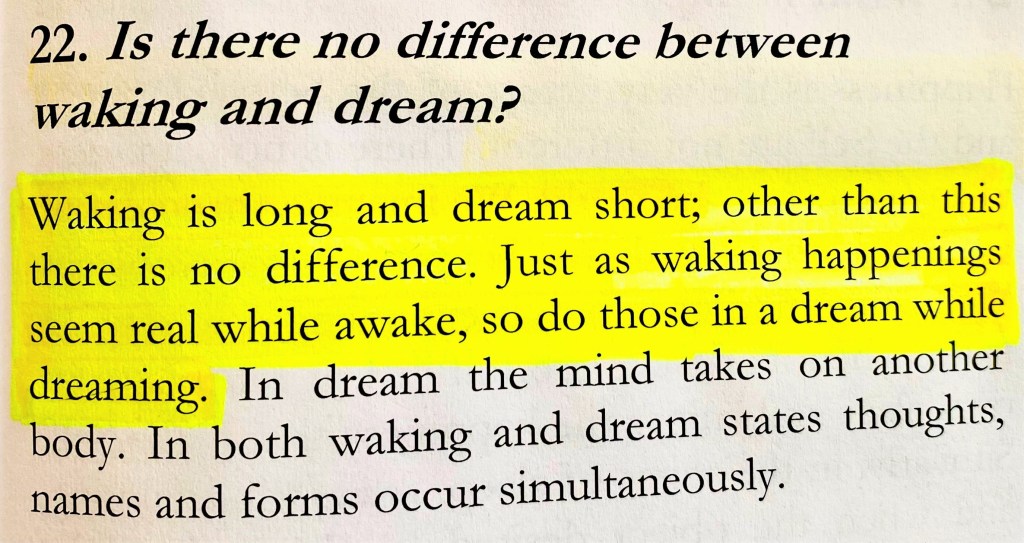
  • When Sri Ramana Maharshi (a realized sage) was questioned about the difference between Dream State and the Waking State (referred to as “reality” by the masses), he replied, “Waking is long and dream short; other than this there is no difference. Just as waking happenings seem real while awake, so do those in a dream while dreaming.”
  • From The Law of Success by Paramahansa Yogananda: “Mind is the creator of everything.” You might think of this as the shaking of the Maya Tree. Please note that he stated that “everything” is created by mind.
  • From The Wish Fulfilled, by Neville Goddard: “This world, which seems so real, is as much a dream as the dreams we encounter while sleeping.”
  • From The Final Truth, by Ramesh S. Balsekar: “All that appears is mind-stuff of which all dreams are made.”
  • From Man’s Eternal Quest, by Paramahansa Yogananda: “Live in the consciousness of Spirit, in that oneness with God wherein you know that life is a dream.”
  • From Before I Am, by Mooji: “World is not. You, me, and all else that you see within and without are unreal; they do not exist independent of yourself. The world you inhabit is created inside your own mind. It is all a dreaming.”
  • From my blog, more proof is offered through this article, entitled “Notes from Beyond.”
  • From William Blake: “As man is, so he sees.”
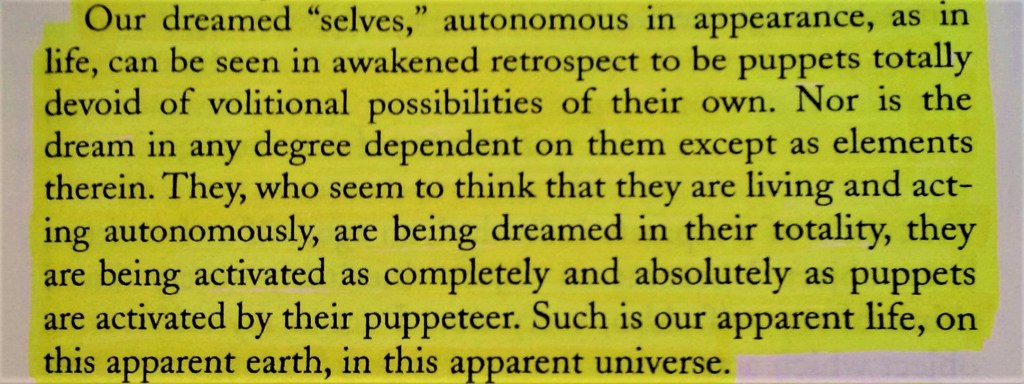
  • And finally, a photo passage from Open Secret, by Wei Wu Wei:

What’s the benefit of knowing this information? If your “life story” is ticking along fine, you’re most likely not reading this article. You’ll be apparently slaying dragons in the business world, or flying to your island home in your personal jet. However, if you’re finding that your story has run full speed into a brick wall, it may help to know that what you have previously assumed to be material “reality” isn’t, indeed, real in the way you’ve assumed. It’s the fruit of the Maya tree; which appears when the mind’s ability to perceive via the senses is functioning. The so-called real world recedes from waking state to dream state (a more ephemeral dream world), and is totally absent in deep sleep, which is without objects, time, and space.

The real Self is That by which the apparent world is co-created and known. So what of “us” is real–for it certainly seems that we exist? Consciousness–independent of form. Please contemplate this: Can anything be known in the absence of Consciousness? If you believe this possible, how could such ever be proven? Is that not like trying to know if the refrigerator light remains “on” when the door is closed? A tree in the forest that supposedly falls unwitnessed, neither exists, falls, or makes a sound; for such requires an observer to co-create the event and report its occurrence.

We are Divine Spirit, dreaming our character’s role of personhood. To know this now, while living, means that one is jivanmukta. If you’re tired of suffering the world of form, please join me on the other side of the bridge. The view is beautiful and eternal. You’re not who you think you are–never have been. You can only be what you are in realitySpirit.

Dare to Dream (and care for one another).

With heartfelt regards,

Art

Copyright © – 2025 – R. Arthur Russell

P.S. Please share this article if you enjoyed it. If you’d like to view my latest book (This Taste of Flesh and Bones), press here. My YouTube videos can be found at Think2wice@I-Am-Aware. May the content of either or both help you along your spiritual journey. Thank You” & “Note to Publishers 🙏🏻🧡

The Fraud Called “Death”

The title of this article isn’t intended as click bait, nor am I attempting to instill a belief system about death. I’m employing the title because it relates to my direct experience of life, itself. Let’s begin with the following stanza from The Psalm of Life, by Henry Wadsworth Longfellow:

Life is real! Life is earnest!
   And the grave is not its goal;
Dust thou art, to dust returnest,
   Was not spoken of the soul
.

So, Mr. Russell, “How can you possibly claim that death is a fraud, especially when we see evidence of it on a daily basis?” If that’s what you’re thinking, please know that I “hear” and respect you. Out of love, I humbly offer the following: I’m not denying that bodies die–obviously, they do. Anything that has an apparent beginning will also have an apparent end. To make sense of the information I’m sharing, it requires that we investigate the essential nature of our “Being”…beyond the superficial assumptions that we’ve been conditioned to accept as true. If we believe (as the majority do) that the sum of all that we are is contained within the body-mind, this article may not only seem insensitive, but also the product of a delusional mind.

Our investigation of our “I”-ness (that sense of “me” which knows our experience) requires that we challenge a collective set of beliefs to which the masses currently subscribe. You may or may not realize that Science can’t explain how biological processes give rise to consciousness. Why? Because Consciousness doesn’t arise from them. Science also states that matter, as conceived by humankind, has no independent existence–it’s actually rendered by the mind. In 1911, Ernest Rutherford proved that atoms, which were once believed to be the foundational “stuff” from which things were made, are actually 99.999% empty space. The following quote from Max Planck, a great theoretical physicist, adds to this understanding:

I regard consciousness as fundamental. I regard matter as derivative from consciousness. We cannot get behind consciousness. Everything that we talk about, everything that we regard as existing, postulates consciousness.”

The key to understanding more about the nature of death is by knowing more about the “reality” in which we apparently live. We never perceive a discrete “world.” We perceive perception–in a similar way that we perceive a “world” in our nighttime dreams. Could it also be, therefore, that the waking-state “world” is made of the same dream stuff? In Who Am I?, the following question was asked of Sri Ramana Maharshi (a realized sage who awakened to his true nature at sixteen):

Are you daring enough to challenge the current interpretation of “reality?” Could Consciousness, indeed, be fundamental and Universal? Is it not true that before you can have any experience that Consciousness must be present? To lend credibility to the information I’m sharing, I offer the following five quotes, which I’ve collected during years of reading:

(From I Am That, Talks with Sri Nisargadatta Maharaj):

(From Open Secret, by Wei Wu Wei):

(From The Abundance Book, by John Randolph Price):

(From The Physics of Consciousness, by Ivan Antic):

(From A Course in Miracles, by Helen Schucman):

Several years ago, I remember reading the following: “We’re not human beings having an occasional spiritual experience; we’re spiritual beings having occasional human experiences.” I actually scoffed at the idea; but such only revealed my own lack of understanding. Could this explain why ancient Grecians inscribed “Know Thyself” on the frontispiece of the Temple of Apollo in Delphi? Yes, most certainly.

To have any experience–of a world, a cup of coffee, or our body-mind–awareness must be present. How else could anything be known? The linchpin of our Being is Awareness. We are That in which the body and the mind appear. Yes, the body dies; but we never were what appeared. We are That which can’t be known via the senses. Buddha referred to It as emptiness. This dramatic change in the way of interpreting reality is often referred to as The Shift.

The body-mind arises out of Consciousness. Through misidentification (which is still being preached by those who believe in a materialist model of the world), we–Spirit–are relentlessly conditioned to believe that we are nothing more than name and form. We are so much more! We are Awareness, having an apparently human experience. It’s impossible to be separated from That which we actually are. It’s why Sri Nisargadatta Maharaj stated:

You can only be what you are in reality. You can only appear to be what you are not.”

I support this through the following verses from the Bible:

(Psalm 46:10):

Be still, and know that I am God:

I will be exalted among the heathen, I will be exalted in the earth.”

(Isaiah 45:5):

I am the Lord, and there is no other;
    apart from me there is no God
.”

Consciousness is the only reality. There’s only one “I Am.”

Dare to dream (and care for one another).

With heartfelt regards,

Art

Copyright © – 2025 – R. Arthur Russell

P.S. Please share this article if you enjoyed it. If you’d like to view my latest book (This Taste of Flesh and Bones), press here. My YouTube videos can be found at Think2wice@I-Am-Aware. May the content of either or both help you along your spiritual journey. Thank You” & “Note to Publishers 🙏🏻🧡

The Awakening of Joshua

The Awakening of Joshua9

Joshua once lived in a house with many mirrors. They seemed everywhere he looked. There were mirrors in the bedrooms; mirrors in the bathrooms; mirrors in the halls; mirrors in the living room, dining room, and grand entrance. All about him, he saw reflections of whom he thought himself to be. The proof seemed inescapable, irrefutable, real. A glance in one of his many mirrors was all it took to reinforce his belief.

There he was–the business man. There he was–the husband. There he was—the father. There he was–through the faculty of memory–the little boy, brimming with innocence, joy, and enthusiasm. And here he was now–the forty-six-year old man, with the personal history of trials and tribulations; the one who was twice divorced, deep in debt, out of shape, lonely, isolated, a workaholic and near alcoholic; a man who was running as fast as he could to keep pace with a world that was forever changing. His identity was also reflected–and reinforced–by and through his interactions with his family, friends, and acquaintances.

Joshua’s view of the world was this: Some people are fortunate enough to be born into a rich family, but most are not. Some individuals get all the lucky breaks, but for most–as in his case–this world is a dog-eat-dog experience. Some people will have healthy bodies most of their lives, but the majority will succumb to one of an infinite list of lurking diseases. On a good day, he could line up his ducks and–with unrelenting attention–keep them in a row. On a bad day, he couldn’t even find them. There was no sense trying to change this reality. It was just the way of the world.

Time passed, until a year came when Joshua–inspired by a deep longing for a more meaningful way of Being in the world–quit work, sold his home, and moved to a cabin that he purchased on a small island. The island, which he nicknamed No Man’s Land, had no other residents. He lived alone there; free to come and go as he pleased. He rose early and stayed up late. He ate, slept, and communed with nature. On the third day, he forgot to wear his watch and never wore it again. Life seemed simpler without time. Soon after, he began a meditation practice and faithfully gave himself to it every day. One morning when he was heading outside for a walk, he noticed a small inscription carved into the back of the cabin’s front door. He assumed it to be from the previous owner. It read: To find yourself, you must lose yourself. Its meaning was perplexing, yet raised a strange but comfortable feeling within him.

Although the cabin was very different from the grand house in which Joshua had once lived, he soon became accustomed to it. Of the noticeable differences was that it had no mirrors–not one. Nowhere in his humble home could Joshua see his reflection. That felt startling at first; for it almost seemed he wasn’t there. There was direct evidence, however, that he was! He was conscious; he was alive; he was living moment to moment on an island. As the days turned into months, Joshua realized he was happier than he had been in years. It felt as though he had shrugged off a heavy burden; for everything about himself and his experiences felt so much lighter–real but unreal. This way of Being felt natural to him, as though a birthright now remembered. The reason?

***

Simple, when we understand the mechanics of how this reality operates; and the nuts and bolts of how it’s constructed. When Joshua moved to the cabin with no mirrors–on an island on which he was the sole resident–there was nothing to reinforce the identity of the false self (the conceptual self, which exists only in the mind and is constructed from a multitude of beliefs and memories). In the light of a deeper reality, his real self–Spirit–had the space to rise up and make itself known. “Here I Am, it whispered, “the One for whom you’ve been longing.” What are the practical implications that relate to the Law of Attraction? First: That, as in Joshua’s case, the person experiencing the problematic life is conceptual…only; nothing more than a fabrication of the mind. Second: That we should continue to dream and create–as that is our nature–but from the wiser and detached perspective of our true self. By doing so, we gain access to an Infinite Well of power and knowledge.

Joshua’s awakening was a process of true recognition; not a single ah–ha moment. As his mind released its stranglehold on his identity, his true essence was free to shine forth. To Joshua, it felt as though he had shrugged off costume after costume after costume; all of which had been worn by a small fictional actor who had no true reality outside of the mind. As compulsive interpretations fell away, the awakened Joshua was left free to live and breathe and have his Being in this world; but with the intimate recognition that he was not–now or ever–of this world.

***

In time, as Joshua’s new way of living stabilized, he left the seclusion of the island and returned to the hustle and bustle of the world. Its hectic pace continued, changing from moment to moment; but he felt grounded in the Unchanging. He felt untouchable–safe, sound, secure. He started a new business and bought a new home. In fact, he fell in love and married again. Knowing what he knew, he chose to focus his attention positively and thereby create a better life. However, the most important change in Joshua’s life came through knowing his true identity. Thus: All painful longing and false belief of separation fell away.

Dare to dream (and care for one another).

With heartfelt regards,

Art

Copyright © – 2020 – R. Arthur Russell

P.S. Please share this article if you enjoyed it. If you’d like to view my latest book (This Taste of Flesh and Bones), press here. My YouTube videos can be found at Think2wice@I-Am-Aware. May the content of either or both help you along your spiritual journey. Thank You” & “Note to Publishers 🙏🏻🧡